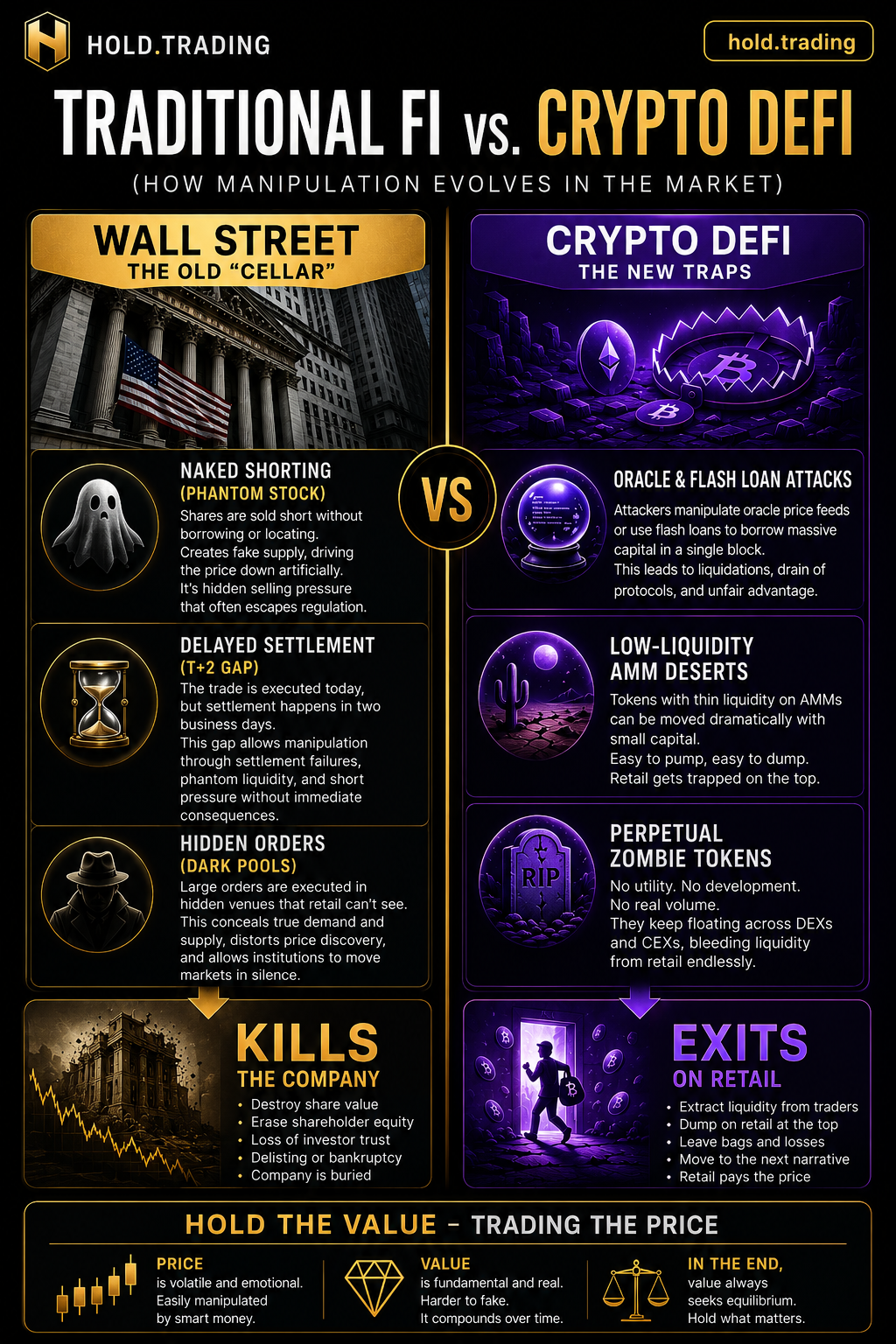
In our previous article, we exposed Cellar Boxing—the traditional Wall Street nightmare where predatory market makers use naked short selling and phantom shares to trap vulnerable companies in a $0.0001 “cellar” for infinite profit.
It is a broken system hidden behind dark pools and delayed settlements. Naturally, a burning question arises: Can Crypto and Blockchain technology fix this?
As believers in the core maxim—“Hold the Value – Trading the Price”—we look to technology to restore true price discovery. The short answer is yes, blockchain technically cures naked shorting. But the long answer? It also births a whole new breed of digital apex predators.
Let’s break down the cure and the new traps.
The Cure: How Blockchain Eradicates Naked Shorting
The entire mechanics of Cellar Boxing rely on two fatal flaws in traditional finance: counterfeit supply (phantom shares) and delayed settlement (T+1/T+2). Blockchain technology inherently bnh-out both flaws through three core pillars:
1. Tokenization Means 1:1 Accountability (RWA)
When assets are brought on-chain via Real World Asset (RWA) tokenization, every single share is represented by a unique, immutable cryptographic token. In a smart contract ecosystem, you cannot sell something that does not exist. To short a tokenized asset, the protocol requires verifiable collateral or an actual on-chain borrow position. Phantom liquidity disappears instantly.
2. Instant Settlement (T+0)
Traditional market makers exploit the multi-day clearing window to delay delivery of shares (creating “Fail-to-Deliver” loops). Blockchain operates on Atomic Settlement. Transactions are executed and settled simultaneously. Money leaves, the asset enters your wallet—instantaneously. There is no time gap left for predators to manipulate.
3. Absolute On-Chain Transparency
Cellar Boxing thrives “under the radar.” On the blockchain, dark pools cannot hide their true volume. Every wallet address, whether belonging to a retail trader or a multi-billion-dollar market maker, is public on the ledger. Anyone can audit who is accumulating, who is dumping, and who is borrowing.
The New Trap: How Crypto Breeds Its Own Manipulation
While blockchain completely solves the “naked shorting” problem, the current crypto landscape is far from a utopian free market. The lack of strict regulatory frameworks and centralized guardrails has allowed whales and market makers to engineer new, sophisticated traps:
1. Oracle Manipulation & Flash Loan Attacks
In traditional finance, predators drive the price down through the order book. In DeFi (Decentralized Finance), they bypass the order book entirely. By using massive capital—or temporary “Flash Loans”—manipulators can artificially distort the price of a token on a single decentralized exchange (DEX). This forces the decentralized price feeds (Oracles) to report a false price, triggering a catastrophic domino effect of automatic liquidations for unsuspecting retail traders.
2. The Low-Liquidity “Ghost Towns”
Just like the OTC Pink Sheets where Cellar Boxing takes place, thousands of micro-cap crypto tokens suffer from zero organic volume. Automated Market Makers (AMMs) govern these liquidity pools. If a predatory entity controls the majority of the liquidity, they can alter the internal pricing algorithms or execute “Wash Trading” (buying and selling to themselves) to artificially trap a token’s price at near-zero levels, hunting long and short liquidations at will.
3. Perpetual Zombie Tokens (The Reverse Cellar)
In Wall Street’s Cellar Boxing, the ultimate goal is to force a company into bankruptcy so the shorts never have to cover. In Crypto, project tokens never truly die. Instead of killing a project entirely, corrupt market makers prefer to let it rot as a “Zombie Token” at $0.00000001. They accumulate the worthless supply over months, only to engineer a sudden, artificial “Pump and Dump” cycle to exit liquidity onto retail buyers, before letting it sink back into the digital cellar.
The Final Verdict for Value Traders
Does Crypto fix Wall Street’s structural corruption? Technically, yes. It provides the most transparent financial architecture ever created, making traditional sins like naked short selling mathematically impossible.
However, technology only changes the rules of engagement, not human nature. The predators have simply traded their hidden order books for exploit-driven smart contracts.
As market participants navigating this evolution, our strategy remains unchanged:
We leverage on-chain data to Hold the underlying Value, while studying the psychological shifts of the whales to Trade the Price.
How do you protect your portfolio from on-chain manipulation? Are RWAs the ultimate future of fair stock trading? Drop your insights in the comments below!
Discuss this post on X